Priming sugar calculator
- Priming sugar for the whole batch (grams)
- 120.2
- Computed on this page from the inputs below
- CO2 the beer already holds (volumes)
- 0.90
- Computed on this page from the inputs below
- CO2 still to be made (grams)
- 58.7
- Computed on this page from the inputs below
- Grams per bottle, if you prime each one
- 2.61
- Computed on this page from the inputs below
The factor table and the 20°C measuring temperature come from HMRC's alcoholic products technical guide; the molecular weights, the molar volume and the Henry's law constants behind the priming figures come from the NIST Chemistry WebBook and CODATA.
Email me this result
We will send you these figures and a link back to them. One email, nothing else unless you tick the box.
The figures above are a worked example (120.2) on the defaults. Change any reading and every line recalculates on your own numbers.
Download the Priming sugar calculator worked example (CSV)
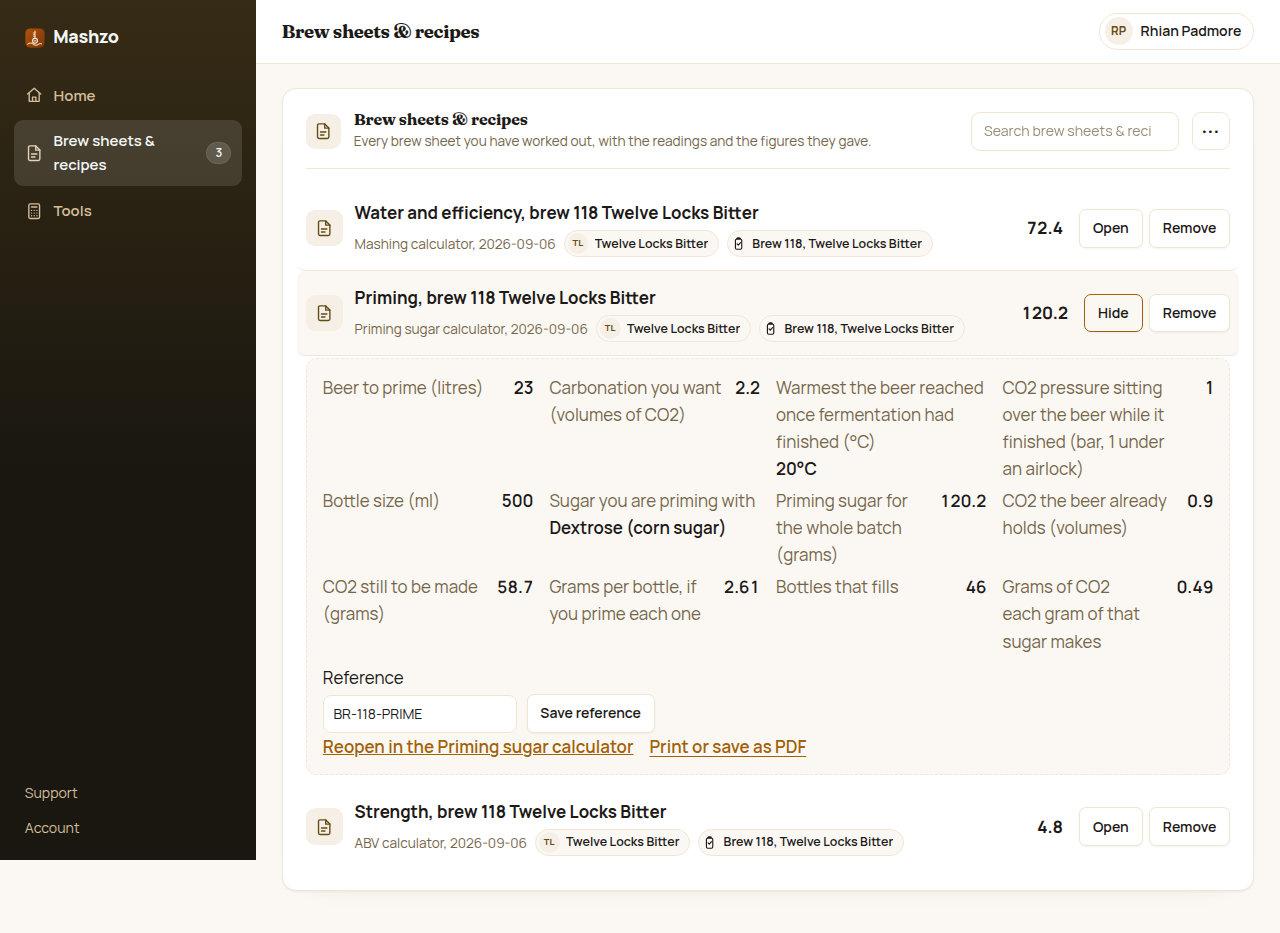
Beer already holds carbon dioxide when fermentation stops, and how much depends on how warm it got. This calculator starts there. The residual figure it uses comes from the Henry's law constants NIST publishes for carbon dioxide in water, 0.035 mol per kilogram per bar at 25°C, with a temperature dependence of 2400 K, converted into volumes with the molecular weight of carbon dioxide and the molar volume of an ideal gas. It subtracts that from the carbonation you want, turns the difference into grams of CO2, and divides by what a gram of your sugar can actually make: 0.49 g for dextrose, 0.51 g for table sugar, straight out of the molecular weights. Every one of those numbers is printed and linked, which is more than a hidden polynomial can offer.
What brewers ask about the Priming sugar calculator
Why does the temperature the beer finished at matter so much?
Carbon dioxide is more soluble in cold beer. A beer that finished at 12°C is carrying about 1.13 volumes before you add anything; the same beer at 24°C is carrying about 0.81. Prime both the same and the cold one comes out nearly a third of a volume fizzier.
Which temperature do I put in, the whole ferment, or the end?
The warmest the beer reached after fermentation had finished. While it is still fermenting the beer is saturated at whatever temperature it is at; once the gas stops coming off, the CO2 it keeps is set by the highest temperature it saw after that.
How much carbonation should I aim at?
British ales are usually 1.5 to 2.0 volumes, most lagers and pale ales 2.2 to 2.6, and wheat beers 3.0 or more. The default here is 2.2. Going much above 3 volumes in a standard glass bottle is how bottles break.
Does it matter whether I use dextrose or table sugar?
Only in the weight. A gram of table sugar makes slightly more CO2 than a gram of dextrose because sucrose inverts into two hexoses, so you need about 5% less of it by weight. The calculator does that swap for you when you change the selector.
Why do you ask for the pressure over the beer?
Because the residual figure is per bar of CO2 sitting on the beer, and under an airlock that is one bar. If you finished under pressure, spunding at, say, 1.7 bar: the beer is holding correspondingly more, and priming for it as though it were flat would over-carbonate the bottles.
Mashzo Pro
Keeping the readings, brew day after brew day
Pro keeps your recipes and your readings, so the efficiency and boil-off you measured last time are already in the boxes next time.
- Keep a brew day's readings so the next one starts from it
- Put two brews side by side and see what changed
- Print brew sheets with your own brew name on them, not ours
- Email a brew sheet to whoever is brewing with you
- Take payment if you sell a batch
- Send what a batch cost through to your books
£3per month, whole team
Start Mashzo Pro Free for 14 days. No card needed. PricingThe first 14 days are free and no card is asked for. Add a card during the trial and the first charge is on the day it ends; do not, and your workspace becomes read-only with nothing deleted. Mashzo Pro is £3 a month. It renews on the same day each month at the same price until you cancel, and the price and the renewal date are shown again before you pay.
Where the constants in this tool come from
NIST CODATA: molar volume of an ideal gas at 273.15 K and 101.325 kPa.