ABV calculator
- Alcohol by volume, percent (rounded down, as duty is)
- 4.8
- Computed on this page from the inputs below
- Degrees the beer attenuated
- 37.0
- Computed on this page from the inputs below
- Original gravity, degrees
- 48.0
- Computed on this page from the inputs below
- Present gravity, degrees
- 11.0
- Computed on this page from the inputs below
The factor table and the 20°C measuring temperature come from HMRC's alcoholic products technical guide; the molecular weights, the molar volume and the Henry's law constants behind the priming figures come from the NIST Chemistry WebBook and CODATA.
Email me this result
We will send you these figures and a link back to them. One email, nothing else unless you tick the box.
The figures above are a worked example (4.8) on the defaults. Change any reading and every line recalculates on your own numbers.
Download the ABV calculator worked example (CSV)
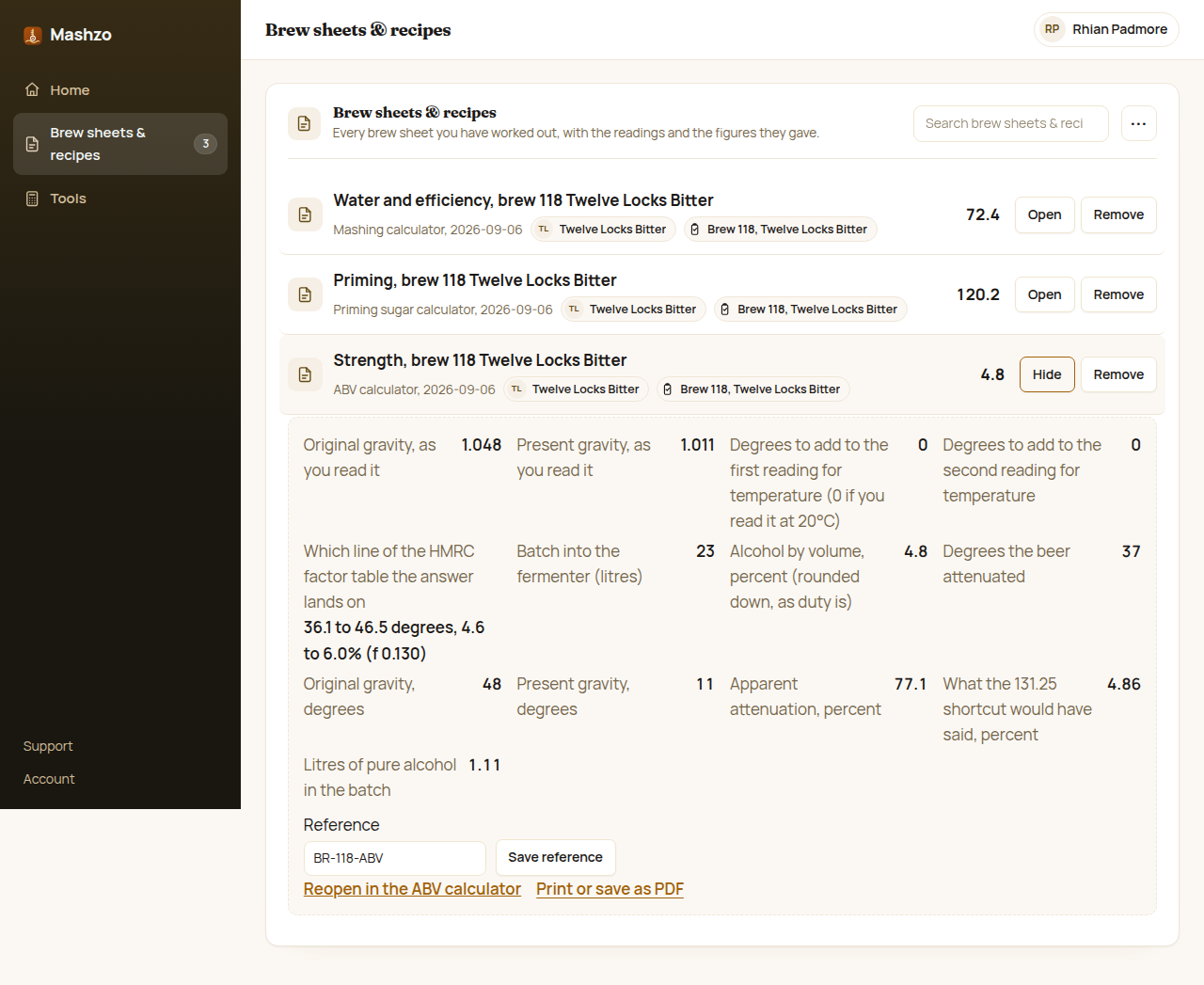
Two hydrometer readings and this works out what the beer came out at, using the method HMRC's alcoholic products technical guide actually sets out rather than the 131.25 shortcut every other calculator uses. Take the degrees the beer attenuated, 1.048 down to 1.011 is 37: and multiply by a factor from a table the Laboratory of the Government Chemist produced. The factor is not constant, because in a weak beer more of the sugar goes into growing yeast than into making alcohol: 0.125 at the bottom of the table, 0.135 at the top, and 0.129 to 0.130 for most beers brewed in this country. Pick the line your answer lands on, and the calculator rounds the strength down to one decimal place, exactly as duty is charged.
What brewers ask about the ABV calculator
Why is this different from the answer my brewing app gives me?
Almost every app multiplies the gravity drop by 131.25. That is a single fitted constant across the whole strength range. HMRC's guide uses a factor that changes with strength, 0.129 to 0.130 for the majority of popular UK beers, 0.131 to 0.133 for beers over 6%, so on a 37-degree drop the two methods differ by about 0.06% ABV, and the gap widens on a strong beer.
Which line of the factor table should I pick?
Start on the 36.1 to 46.5 degrees line, factor 0.130, which covers most ordinary-strength beer. Read the answer, and if it falls outside the ABV range that line names, switch to the line whose range it lands in and read it again. That is exactly how the published table is meant to be used.
Do I have to correct my gravity readings for temperature?
HMRC's guide measures alcoholic strength at 20°C, so a reading taken warmer or colder needs the correction from your own hydrometer's card before it goes in. The two correction boxes take that adjustment in degrees of gravity; leave them at zero if you read the sample at 20°C, or if you brought it to 20°C first.
Is this good enough for the strength on a label?
No. HMRC's guide sets out a laboratory method (distillation, then density in air at 20°C read against the Laboratory Alcohol Table) and where duty or a label depends on the strength, that is the method that counts. The factor calculation is what the guide offers a producer with no or minimal laboratory facilities.
What is apparent attenuation, and why is it not the same as the ABV?
Apparent attenuation is the share of the original degrees that fermented away, 37 of 48 is 77.1%: and it tells you how far the yeast got, not how much alcohol there is. It is 'apparent' because alcohol is lighter than water, so a hydrometer in finished beer reads lower than the real sugar left would suggest.
Mashzo Pro
Keeping the readings, brew day after brew day
Pro keeps your recipes and your readings, so the efficiency and boil-off you measured last time are already in the boxes next time.
- Keep a brew day's readings so the next one starts from it
- Put two brews side by side and see what changed
- Print brew sheets with your own brew name on them, not ours
- Email a brew sheet to whoever is brewing with you
- Take payment if you sell a batch
- Send what a batch cost through to your books
£3per month, whole team
Start Mashzo Pro Free for 14 days. No card needed. PricingThe first 14 days are free and no card is asked for. Add a card during the trial and the first charge is on the day it ends; do not, and your workspace becomes read-only with nothing deleted. Mashzo Pro is £3 a month. It renews on the same day each month at the same price until you cancel, and the price and the renewal date are shown again before you pay.